Felt Wick
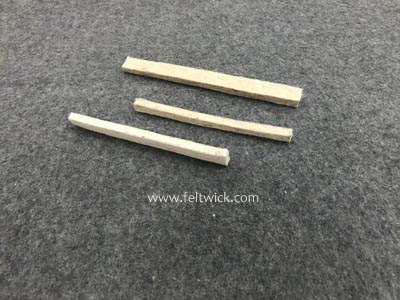
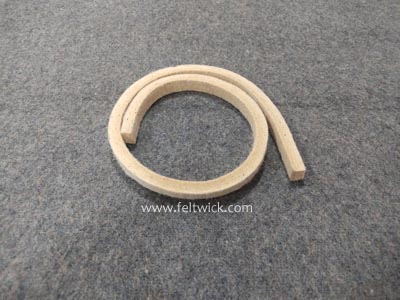
What is felt wick :
Felt wick also referred as wicking felt is a wool felt material that conveys any liquid by capillary action, they are loose wool fibers are pressed and felted to any shape and size as per requirement. Wool felt wicking which is made from natural wool fiber, by nature attracts and draws up any liquid including oil and water, transfers it to the end through capillary action. Wool felt wick absorbs, draw and conveys, drain the moisture or any fluid, liquid, chemicals and acid in slow steady controlled manner and in high flow rate to the end.
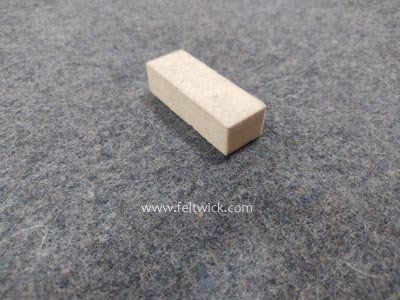
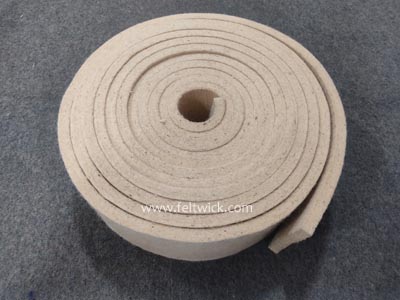
Felt wicking material types, composition :
Wool and cotton fiber are best suited for moisture or water wicking and
absorption.
Wool wick made from wool is a natural fiber, environment friendly and is the best
moisture wicking material, comes in in different shapes and sizes.
Merino wool can be blended in combination with cotton and synthetic fibers.
For acid wicking the natural fiber quickly degrades and decomposes as it is attacked by acid.
Synthetic fiber like Polyester or polypropylene is best for Acid or Alkaline Wicking.
Fibers can be pressed to form felt wicking pad, or a bundle of
fibers can be loosely twisted, braided or spun to yarn or thread which can also
be used as wicking yarn or wicking thread. It can
further processed in manufacturing of a woven cord or twisted to
rope. The weave greatly increases the tensile strength and reduces the
chance of splitting. Woolen yarn can also be woven into fabric and felted making the
fibers interlocked creating a flexible single direction or multi
direction Woven Felt wick.
Upon Visual magnification wick it can be observed that of the fibers are
simply pressed or needled punched into one another whereas compared with
woven felt clearly reveals the intricate weave. The weave greatly
increases the tensile strength and reduces the chance of splitting.
Consequently, in almost every application for wicking, woven wool felt
will outperform pressed counterparts. Since there are so many variables
in wicking, only testing can provide a final answer.
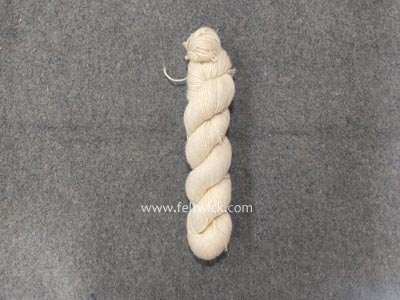
Appearance - Colors:
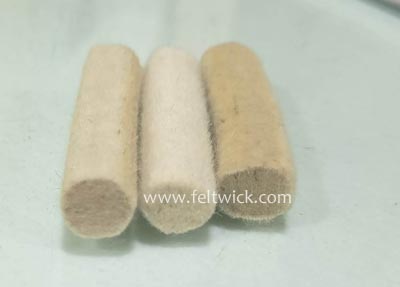
Wicking felt is generally Off white or cream and Gray in color. Black colored felt wick is also manufactured.
It can be dyed in any color like Red, Green, Yellow, Blue, Brown or to any shade as per choice.
F1 wick is white in color and F3 is grey in color.
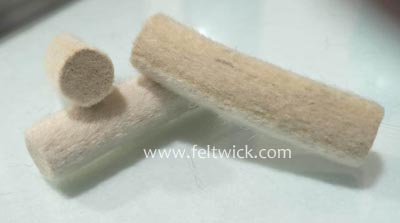
Density / Hardness:
We are manufacturer of felt wick in different hardness.
The wicking capability depends upon the density of the
felt. Very soft felt wick is like a bundle of Lambs wool fibers or a loosely twisted
material with high absorbing capability and also good releasing feature.
Soft felt wick has density between 0.16 grams/cm3 to 0.22
grams/cm3. Medium hard felt wick has density from 0.26 grams/cm3 to 0.32 grams/cm3 and hard grade refers to 0.36 grams/cm3 and above.
Having low density and hardness means high absorbing and fast transfer, releasing. Medium hard are flexible grade with balanced feature.
Good Hardness absorbs slowly and retains the oil or the liquid. Woolen Felt has excellent wicking properties. Density is
calculated as grams per cubic cm.
Shapes & sizes :
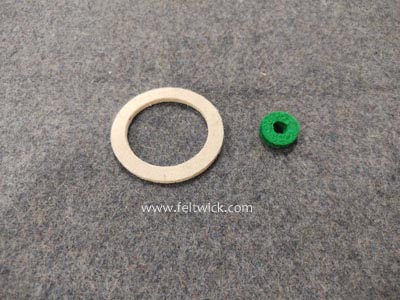
We can offer you wicking felt in any shape and size.
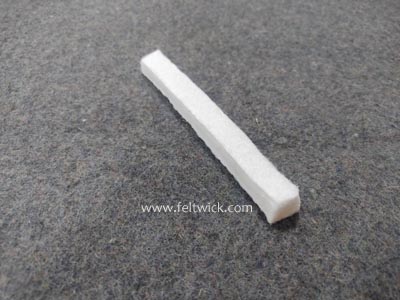
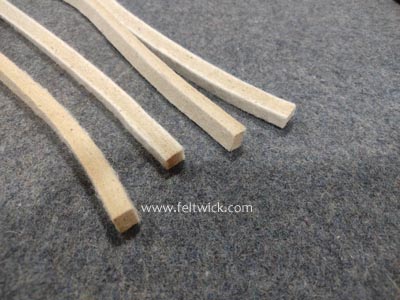
Felt can be cut to fit custom holders. Wicking pad is made in thickness from 1 mm to 30 mm. These wicker pads
can be cut in form of wicking strip and wick tape.
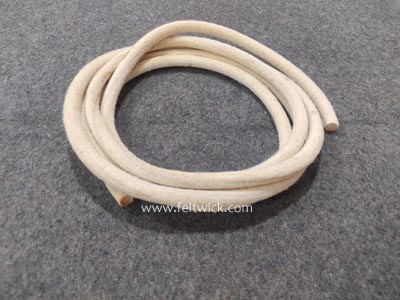
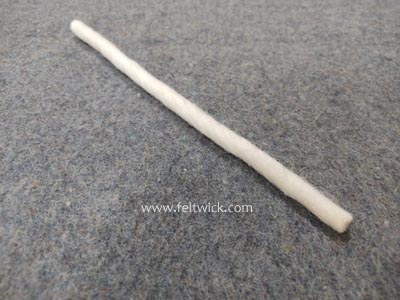
Round Felt Wick are rope, cord like structure manufactured in different diameter,
measured in Inch - 1/8”, 5/32”, 3/16”, 1/4”, 5/16”, 3/8”, 1/2”, 3/4”and 1".
Felt wicks are specially manufactured in two colors from
pressed wool felt - either white F-1 felt, or grey F-3 felt.
How does Wicking Work?
Wicking works by utilizing a process called as capillary action.
It is the process of a liquid flowing in a narrow space without any
assistance. Felt wick are made from fibers and they have tiny
narrow gaps in between fibers where liquid can fill in these gaps in the
wool felt fibers retains the fluid and it acts like a oil reservoir
and transfer the fluids into the areas, move up to
next gap or space,
by the absorbing nature of fiber, any liquid or oil is quickly
absorbed and travels in path direction of fiber, uniformly and
predictable manner, thereby creating a capillary
motion and defying opposition to, any external forces like gravity
and creating a continuous flow momentum until it reaches the end part.
For Example : A wax candle where the twisted cotton thread draws up liquid
melted wax and delivering it to the base of the flame as fuel for
illumination, creating a continuous flow and supply of fuel. An
oil lamp that by capillary attraction draws up paraffin wax oil or
kerosene oil with a steady supply of the oil to the flame.
Wicking time & Liquids :
Wicking time depends upon 2 factors mainly, wicking material and the
liquid. Wick material can be classified further to fiber
composition like Wool, Cotton, Polyester, Polypropylene. Structure or
manufacturing pattern or construction, depending upon the fiber
direction the flow is determined. If it is woven into multi directional
then it will spread uniformly instead of going in a single direction and
slowing the wicking time. The thickness and shape determines the
quantity of any liquid, water or oil transfer.
Depending upon the Density the flow rate can be adjusted, density is
grams per centimeter cube or pounds / yard, the transfer is determined
by the quantity of liquid transferred in particular time like 5 ml
absorption in 12 seconds. The travel time or transfer rate can be
measured in millimeter (mm) or cm per second to inches in hour. We are
manufacturer and supplier of felt wick and all types of
Fluid or liquid can be transferred with our felt Wick in controlled
manner whether it is Water, Oil or even acid. Our water wicking felt
can retain moisture from air and release water when it is dry and
requires water. Oil wicking felt material is best suited for oil
wicking, it can transfer all types of oil, synthetic or light crude with
API gravity greater than 31. Any hydrocarbons like Acetone, Toluene .
Our acid wicking felt can retain and transfer diluted or
concentrated acids. The viscosity of liquid impacts the flow rate
and time, Heavy or High viscous liquid which are slowly absorbed are
also have longer wicking time.
A felt strip can be effectively be utilized in
applications for wicking of solvents, grease, ink, oil, perfumes, or
water.
Guidelines and Standard:
We follow strict guidelines in manufacturing
Wool Felt with International Standards. In Russia
GOST - ГОСТ 13330-77 specifies Felt wicks and plates.
This standard applies to felt thin-haired cylindrical and flat wicks and
plates used in mechanical engineering for supplying lubricant to machine
components.
Features / Advantages :
Felt has extraordinary and tremendous wicking capabilities, delivering consistent
fluid flow without material deterioration.
Felt is extremely absorbent and can retain many times its weight in
fluids. Its quality is not compromised by continuous
oil saturation.
Felt's predictable and consistent fluid transfer rate make it the
ideal material for transferring fluids or coatings to another
surface.
Does felt wick moisture ? Yes, our felt are specially crafted to
wick moisture.
Does felt wick oil ? Yes, our
felt oil wick is excellent material in absorption and transmission
of oil. It can be completely soaked and submerged in Oil for
absorption and it retains it and also releases it when required.
Function and properties :
•
Retaining : Soaking , Ink absorbing and
Storing - It functions as the core
absorbent pad inside standard stamp pads.
• Transmission : It is used as Fluid Transfer in paint markers to
draw fluid from storage and dispense it
evenly.
•
Lubrication : Oil Lubricating wick , Widely used in
automotive and industrial machinery, a felt wick acts as both a
reservoir and a delivery system, consistently passing oil onto
moving shafts and bearings.
• Filtration: Felt wick is made up of
Wool fibers. Its dense twingled fiber traps particulate matter while
allowing liquids or vapors to pass through, making it highly
effective for air and oil filters.
Uses & Application :
•
Wick for Automatic Self Watering System for Plants, Siphoning Plant
Feeding Wick
•
Ink Pads Applicators - Some common
areas where our wool felt is used for wicking purpose are in ink pad
•
Motor and Starter as Oil Wick, Shaft Lubricating and Bearings.
•
Wick Lubricator in traction motor in
locomotives.
• Guide rail lubricators for Elevator / Lift
- Wick felt for Elevator Door Track Lubricator in size of 75 X 25 X
10 mm
• Polish rod lubricator for stuffing box - Our felt wick inside
polish rod lubricator provides convenient polished rod lubrication
for your stuffing box. These lubricator wicks are perfectly sized to
fit a variety of polish rod lubricator boxes, ensuring a snug and
effective lubrication. It prevents friction, stops the rod from
burning out the packing rubbers, and avoids wellhead leaks. While
the stuffing box is designed to seal around the polished rod, our
felt wick prevents lubricating fluids from escaping while allowing
the rod to move. The constant movement of the polished rod through
the stuffing box can lead to friction, potentially wearing down the
rod itself , that is why our felt wick is preferred , it lubricates
the moving polished rod so that it doesn't overheat and destroy the
packing. They are generally used in heavy-duty machinery like
oilfield sucker-rod pumps and railway axles to reduce friction and
prevent fluid leakage.
•
In fighter aircraft, felt wicks (or capillary wicks) made of wool
fibers which are porous structures inside are primarily
used in vapor cycle Environmental Control Systems (ECS), avionics
cooling cold plates, and heat pipes to provide two-phase,
capillary-pumped cooling for sensitive electronics, oxygen
concentrators, and radar/weapon systems. They
enable fluid circulation without mechanical pumps by using capillary
action to continuously return condensed refrigerant to the
evaporator. Our Felt Wick is a specialized pure woollen wick used as a
component in the turbo cooler of the oxygen and weapon systems on
fighter aircraft. The vapor travels to the cold side, condenses, and
returns to the hot side via our wick.
•
Stitching machine : A felt oil wick in a sewing machine is a small cylinderical piece of wool felt
designed to absorb and hold sewing machine oil.
It absorbs oil and slowly releases the oil via capillary
action to continuously lubricate fast-moving high-friction
components (like the shuttle hook, race, and needle bar) without
causing a mess. In Bobbin / Shuttle Area it is
placed inside a small spring or tube directly against the spinning
hook and race. In Upper Machine Head it is Hidden near the needle
bar or take-up lever to ensure the upper mechanisms remain
lubricated. Also used in Internal Bearings, sliding blocks and
crankshafts.
• Vintage motorcycle swing arms - A
cylinderical shaped highly absorbent, dense wool felt used in
swing arm to retain and gradually transfer lubricating oil to pivot
points, bearings, and pins. It acts as both a reservoir and an
applicator, ensuring a consistent film of lubrication while
preventing leaks or dry friction.
• Oil wick in Lathe machine :
An capillary oil wick for lubrication is used in vintage and manual
lathes. It uses capillary action to draw oil from a reservoir up
over a barrier and down into bearing surfaces or gears at a slow,
consistent drip rate.
• Splash-Lubricated Gearboxes : In gravity
systems, felt wicks are typically part of a drip-feed or siphon
oiler. A siphon oil felt wick hangs from the reservoir into a
distribution channel. The felt wick draws the oil up and over the
reservoir edge, dripping it consistently into the gear train or
bearing housing below. They prevent dry starts, filter out metal
debris, and ensure continuous lubrication.
Prices :
Felt wick price depends upon Size , Quality and Quantity . Many
factors influence the Price , sold individually in per piece
basis, in Bulk rolls and purchase in Quantity the range is big ,
starts from US $ 5 per kg to $ 50 per Kg.
We can offer you high quality wool felt for wicking purposes. They will deliver constant and consistent wick flow . Our
wicking felt is highly absorbent in nature and it can absorb much
more then its original weight and has predictable fluid transfer .
We are manufacturer and supplier of felt wick, you can buy
online, please contact us with details of your requirement.
We are the preferred choice among Felt wick manufacturers. We are reliable felt wick suppliers,
made by experienced professionals using best material and fast
delivery. Our quality system ensures that wicks are free from any
defects.